The MacBook Neo is now Apple’s entry-level MacBook, undercutting the MacBook Air by $500. To deliver such a dramatically lower price, the MacBook Neo has a significant number of tradeoffs. Here’s everything that’s different between the two devices.
Apple’s introduction of the MacBook Neo expands the company’s laptop lineup with a far more affordable entry point, sitting well below the MacBook Air in both price and capability. While the two machines share a similar size and lightweight design, they are aimed at very different types of users. The MacBook Neo focuses on delivering the essentials of the Mac experience at the lowest possible cost, while the MacBook Air offers significantly more performance, features, and flexibility.
Design
The MacBook Neo and the 13-inch MacBook Air have similar dimensions. The MacBook Air remains thinner, but the MacBook Neo has a slightly smaller overall footprint owing to its smaller display. Both machines weigh 2.7 pounds (1.23 kg).
MacBook Neo
MacBook Air
Height
0.50 inch (1.27 cm)
0.44 inch (1.13 cm)
Width
11.71 inches (29.75 cm)
11.97 inches (30.41 cm)
Depth
8.12 inches (20.64 cm)
8.46 inches (21.5 cm)
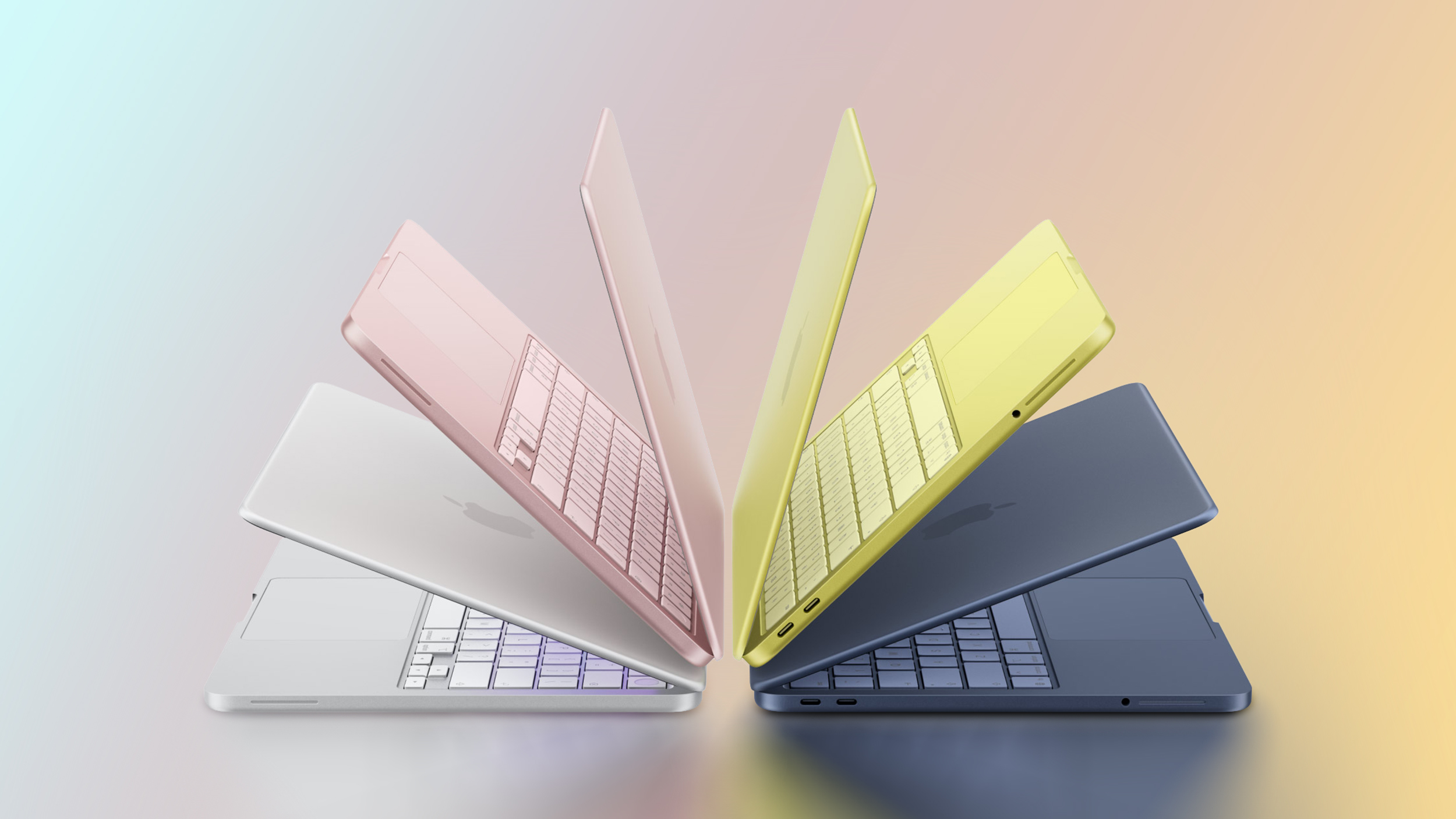
There are still some notable design differences. The MacBook Neo does not have a backlit keyboard or a haptic trackpad, and only has Touch ID when configured with 512GB of storage for an extra $100. They are also available in different selections of color options, with the MacBook Neo’s color extending to the Magic Keyboard in a lighter shade.
MacBook Neo
MacBook Air
Available in Silver, Blush, Indigo, and Citrus
Available in Silver, Sky Blue, Midnight, and Starlight
Touch ID on 512GB models only
Touch ID
Magic Keyboard or Magic Keyboard with Touch ID
Backlit Magic Keyboard with Touch ID
Color-matched Magic Keyboard
Black Magic Keyboard
Mechanical Multi-Touch trackpad
Haptic Force Touch trackpad with pressure-sensing capabilities
Display “notch”
Display
The MacBook Air’s display is slightly larger and supports True Tone and P3 wide color. Both are Liquid Retina displays with 500 nits of brightness.
MacBook Neo
MacBook Air
13-inch Liquid Retina display
13.6-inch Liquid Retina display
(15-inch model also available)
2408 by 1506 pixel resolution
2560 by 1664 pixel resolution
sRGB
Wide color (P3)
True Tone technology
Thicker display borders
Slimmer display borders
Performance
The MacBook Neo is Apple’s first Mac to contain an iPhone chip. The A18 Pro is still a capable chip, but the M5 is around 20% faster for single-core tasks and 80% faster for multi-core tasks. The M5 chip also has more than double the GPU throughput of the A18 Pro and features Neural Accelerators.
MacBook Neo
MacBook Air
Apple A18 Pro chip
Apple M5 chip
Made with TSMC’s second-generation 3nm process (N3E)
Made with TSMC’s third-generation 3nm process (N3P)
6-core CPU
10-core CPU
5-core GPU
8-core GPU
Neural Accelerators
8GB unified memory
16GB, 24GB, or 32GB unified memory
60GB/s memory bandwidth
153GB/s memory bandwidth
Battery and Charging
The MacBook Air has up to two hours of extra battery life over the MacBook Neo, along with support for charging via MagSafe 3 and fast charging.
MacBook Neo
MacBook Air
Integrated 36.5-watt-hour lithium-ion battery
Integrated 53.8-watt-hour lithium-polymer battery
16-hour battery life
18-hour battery life
MagSafe 3 charging
Fast-charge capable with 70W USB-C Power Adapter or higher
Comes with 20W USB-C Power Adapter
Comes with 40W Dynamic Power Adapter with 60W Max
Cameras, Speakers, and Microphones
The MacBook Air has a superior array of camera and audio hardware, resulting in a slightly better experience with video calls, listening to music, and recording audio.
MacBook Neo
MacBook Air
1080p FaceTime HD camera
12MP Center Stage camera
LED webcam indicator light
Desk View support
Dual-speaker sound system
Four-speaker sound system
Spatial Audio with dynamic head tracking when using supported AirPods
Dual-mic array with directional beamforming
Three-mic array with directional beamforming
Connectivity
The MacBook Neo’s connectivity is more limited than that of the MacBook Air. While both have two USB-C ports, the MacBook Air’s are considerably more capable in terms of data transfer and external display support.
MacBook Neo
MacBook Air
Wi-Fi 6E connectivity
Wi-Fi 7 connectivity
One USB 3 (10 Gb/s) port and one USB 2 port (480 Mb/s)
Two Thunderbolt 4 ports (40 Gb/s)
Support for one 4K external display at 60Hz
Support for two 6K external displays up 60Hz or 4K at 144Hz
3.5mm headphone jack
3.5mm headphone jack with support for high-impedance headphones
Magnetic MagSafe 3 charging port
Other Differences
The most significant difference between the MacBook Neo and the MacBook Air is price: The MacBook Air costs $500 more. It is also much more configurable, with higher amounts of memory and storage available.
MacBook Neo
MacBook Air
Ambient light sensor
256GB or 512GB storage
512GB, 1TB, 2TB, or 4TB storage
Starts at $599
Starts at $1,099
Which to Choose?
Choosing between the MacBook Neo and the MacBook Air primarily comes down to how demanding your needs are and how much you want to spend. The MacBook Neo is clearly positioned as Apple’s most accessible notebook, delivering the core Mac experience at the lowest possible price. For users who primarily need a reliable computer for basic everyday tasks, the Neo provides enough performance. Its lower cost also makes it an appealing option for households purchasing multiple computers, such as for kids or family use.
For first-time Mac owners, the MacBook Neo is also likely to be the most sensible starting point. It offers the same software experience as Apple’s more expensive laptops, allowing new users to explore the platform without a large financial commitment. In many cases, buyers moving from inexpensive Windows laptops or Chromebooks will find the Neo significantly faster and better built than devices in the same price range.
The MacBook Air, by contrast, is aimed at users who expect higher performance, greater longevity, and a more feature-rich, premium experience. Its more powerful M5 chip, memory options, larger display, and significantly more capable connectivity make it far better suited to multitasking, professional workloads, and creative applications. Users who regularly work with large files, run demanding software, connect multiple external displays, or want a machine that will remain comfortable to use for many years will benefit from choosing the Air.
In practical terms, the MacBook Neo is best viewed as a budget entry point into the Mac lineup, while the MacBook Air remains Apple’s mainstream ultraportable for most people. Buyers who simply want a dependable Mac for everyday computing can save money with the Neo, but those who want stronger performance, better hardware features, and a laptop that will scale to more demanding tasks over time should consider spending the extra money on the MacBook Air.
This article, “MacBook Neo vs. MacBook Air Buyer’s Guide: 40 Differences Compared” first appeared on MacRumors.com
Discuss this article in our forums
The MacBook Neo is now Apple’s entry-level MacBook, undercutting the MacBook Air by $500. To deliver such a dramatically lower price, the MacBook Neo has a significant number of tradeoffs. Here’s everything that’s different between the two devices.
Apple’s introduction of the MacBook Neo expands the company’s laptop lineup with a far more affordable entry point, sitting well below the MacBook Air in both price and capability. While the two machines share a similar size and lightweight design, they are aimed at very different types of users. The MacBook Neo focuses on delivering the essentials of the Mac experience at the lowest possible cost, while the MacBook Air offers significantly more performance, features, and flexibility.
Design
The MacBook Neo and the 13-inch MacBook Air have similar dimensions. The MacBook Air remains thinner, but the MacBook Neo has a slightly smaller overall footprint owing to its smaller display. Both machines weigh 2.7 pounds (1.23 kg).
MacBook Neo
MacBook Air
Height
0.50 inch (1.27 cm)
0.44 inch (1.13 cm)
Width
11.71 inches (29.75 cm)
11.97 inches (30.41 cm)
Depth
8.12 inches (20.64 cm)
8.46 inches (21.5 cm)
There are still some notable design differences. The MacBook Neo does not have a backlit keyboard or a haptic trackpad, and only has Touch ID when configured with 512GB of storage for an extra $100. They are also available in different selections of color options, with the MacBook Neo’s color extending to the Magic Keyboard in a lighter shade.
MacBook Neo
MacBook Air
Available in Silver, Blush, Indigo, and Citrus
Available in Silver, Sky Blue, Midnight, and Starlight
Touch ID on 512GB models only
Touch ID
Magic Keyboard or Magic Keyboard with Touch ID
Backlit Magic Keyboard with Touch ID
Color-matched Magic Keyboard
Black Magic Keyboard
Mechanical Multi-Touch trackpad
Haptic Force Touch trackpad with pressure-sensing capabilities
Display “notch”
Display
The MacBook Air’s display is slightly larger and supports True Tone and P3 wide color. Both are Liquid Retina displays with 500 nits of brightness.
MacBook Neo
MacBook Air
13-inch Liquid Retina display
13.6-inch Liquid Retina display
(15-inch model also available)
2408 by 1506 pixel resolution
2560 by 1664 pixel resolution
sRGB
Wide color (P3)
True Tone technology
Thicker display borders
Slimmer display borders
Performance
The MacBook Neo is Apple’s first Mac to contain an iPhone chip. The A18 Pro is still a capable chip, but the M5 is around 20% faster for single-core tasks and 80% faster for multi-core tasks. The M5 chip also has more than double the GPU throughput of the A18 Pro and features Neural Accelerators.
MacBook Neo
MacBook Air
Apple A18 Pro chip
Apple M5 chip
Made with TSMC’s second-generation 3nm process (N3E)
Made with TSMC’s third-generation 3nm process (N3P)
6-core CPU
10-core CPU
5-core GPU
8-core GPU
Neural Accelerators
8GB unified memory
16GB, 24GB, or 32GB unified memory
60GB/s memory bandwidth
153GB/s memory bandwidth
Battery and Charging
The MacBook Air has up to two hours of extra battery life over the MacBook Neo, along with support for charging via MagSafe 3 and fast charging.
MacBook Neo
MacBook Air
Integrated 36.5-watt-hour lithium-ion battery
Integrated 53.8-watt-hour lithium-polymer battery
16-hour battery life
18-hour battery life
MagSafe 3 charging
Fast-charge capable with 70W USB-C Power Adapter or higher
Comes with 20W USB-C Power Adapter
Comes with 40W Dynamic Power Adapter with 60W Max
Cameras, Speakers, and Microphones
The MacBook Air has a superior array of camera and audio hardware, resulting in a slightly better experience with video calls, listening to music, and recording audio.
MacBook Neo
MacBook Air
1080p FaceTime HD camera
12MP Center Stage camera
LED webcam indicator light
Desk View support
Dual-speaker sound system
Four-speaker sound system
Spatial Audio with dynamic head tracking when using supported AirPods
Dual-mic array with directional beamforming
Three-mic array with directional beamforming
Connectivity
The MacBook Neo’s connectivity is more limited than that of the MacBook Air. While both have two USB-C ports, the MacBook Air’s are considerably more capable in terms of data transfer and external display support.
MacBook Neo
MacBook Air
Wi-Fi 6E connectivity
Wi-Fi 7 connectivity
One USB 3 (10 Gb/s) port and one USB 2 port (480 Mb/s)
Two Thunderbolt 4 ports (40 Gb/s)
Support for one 4K external display at 60Hz
Support for two 6K external displays up 60Hz or 4K at 144Hz
3.5mm headphone jack
3.5mm headphone jack with support for high-impedance headphones
Magnetic MagSafe 3 charging port
Other Differences
The most significant difference between the MacBook Neo and the MacBook Air is price: The MacBook Air costs $500 more. It is also much more configurable, with higher amounts of memory and storage available.
MacBook Neo
MacBook Air
Ambient light sensor
256GB or 512GB storage
512GB, 1TB, 2TB, or 4TB storage
Starts at $599
Starts at $1,099
Which to Choose?
Choosing between the MacBook Neo and the MacBook Air primarily comes down to how demanding your needs are and how much you want to spend. The MacBook Neo is clearly positioned as Apple’s most accessible notebook, delivering the core Mac experience at the lowest possible price. For users who primarily need a reliable computer for basic everyday tasks, the Neo provides enough performance. Its lower cost also makes it an appealing option for households purchasing multiple computers, such as for kids or family use.
For first-time Mac owners, the MacBook Neo is also likely to be the most sensible starting point. It offers the same software experience as Apple’s more expensive laptops, allowing new users to explore the platform without a large financial commitment. In many cases, buyers moving from inexpensive Windows laptops or Chromebooks will find the Neo significantly faster and better built than devices in the same price range.
The MacBook Air, by contrast, is aimed at users who expect higher performance, greater longevity, and a more feature-rich, premium experience. Its more powerful M5 chip, memory options, larger display, and significantly more capable connectivity make it far better suited to multitasking, professional workloads, and creative applications. Users who regularly work with large files, run demanding software, connect multiple external displays, or want a machine that will remain comfortable to use for many years will benefit from choosing the Air.
In practical terms, the MacBook Neo is best viewed as a budget entry point into the Mac lineup, while the MacBook Air remains Apple’s mainstream ultraportable for most people. Buyers who simply want a dependable Mac for everyday computing can save money with the Neo, but those who want stronger performance, better hardware features, and a laptop that will scale to more demanding tasks over time should consider spending the extra money on the MacBook Air.Related Roundup: MacBook AirTag: MacBook (A18 Pro)Buyer’s Guide: 15″ MacBook Air (Buy Now), 13″ MacBook Air (Buy Now)Related Forum: MacBook AirThis article, “MacBook Neo vs. MacBook Air Buyer’s Guide: 40 Differences Compared” first appeared on MacRumors.comDiscuss this article in our forums Read More MacRumors: Mac News and Rumors – All Stories
#Techno #PCWorld