

The Future of ABAP Development: SAP Joule, AI Assistants, and Agentic Development Capabilities
How AI is transforming the way we write, understand, and maintain ABAP code
Introduction
The ABAP development landscape is undergoing a seismic shift. After decades of relatively stable tooling, 2025-2026 marks a turning point where AI capabilities are no longer experimental add-ons but integral parts of the developer experience. From SAP’s official Joule for Developers to community-driven initiatives like YAAI (Yet Another ABAP AI), ABAP developers now have access to tools that can generate code, explain complex logic, build AI agents, and even act as autonomous collaborators.
This post explores the current state and future direction of AI-assisted ABAP development, covering both SAP’s strategic investments and the vibrant open-source ecosystem emerging around agentic AI.
Part 1: SAP Joule for Developers — The Official AI Copilot
What Is Joule for ABAP?
SAP Joule for Developers, ABAP AI capabilities is SAP’s official AI copilot for ABAP development, integrated directly into ABAP Development Tools (ADT) for Eclipse. Trained on millions of lines of ABAP code, Joule understands ABAP Cloud patterns, RAP (RESTful ABAP Programming), CDS (Core Data Services), and modern ABAP syntax.
Current Capabilities (2025)
Feature
Description
Predictive Code Completion
Ghost text suggestions as you type, optimized for ABAP Cloud-compliant patterns
Code Explanation
Select any ABAP code or CDS view entity and receive natural-language explanations
Unit Test Generation
Automatically generate ABAP Unit test classes for both ABAP code and CDS entities
CDS Test Generation
Create test classes specifically for CDS view entities
Joule Chat
Embedded chatbot in ADT for ABAP-related questions — syntax, RAP concepts, migration guidance
Who Can Use It?
Joule’s ABAP AI capabilities are currently available for:
• SAP BTP ABAP Environment• SAP S/4HANA Cloud, Public Edition
Important: The free/limited offering expires September 15, 2025. Contact your SAP account executive for ongoing access.
Part 2: The 2026 Roadmap — From Copilot to Autonomous Collaborator
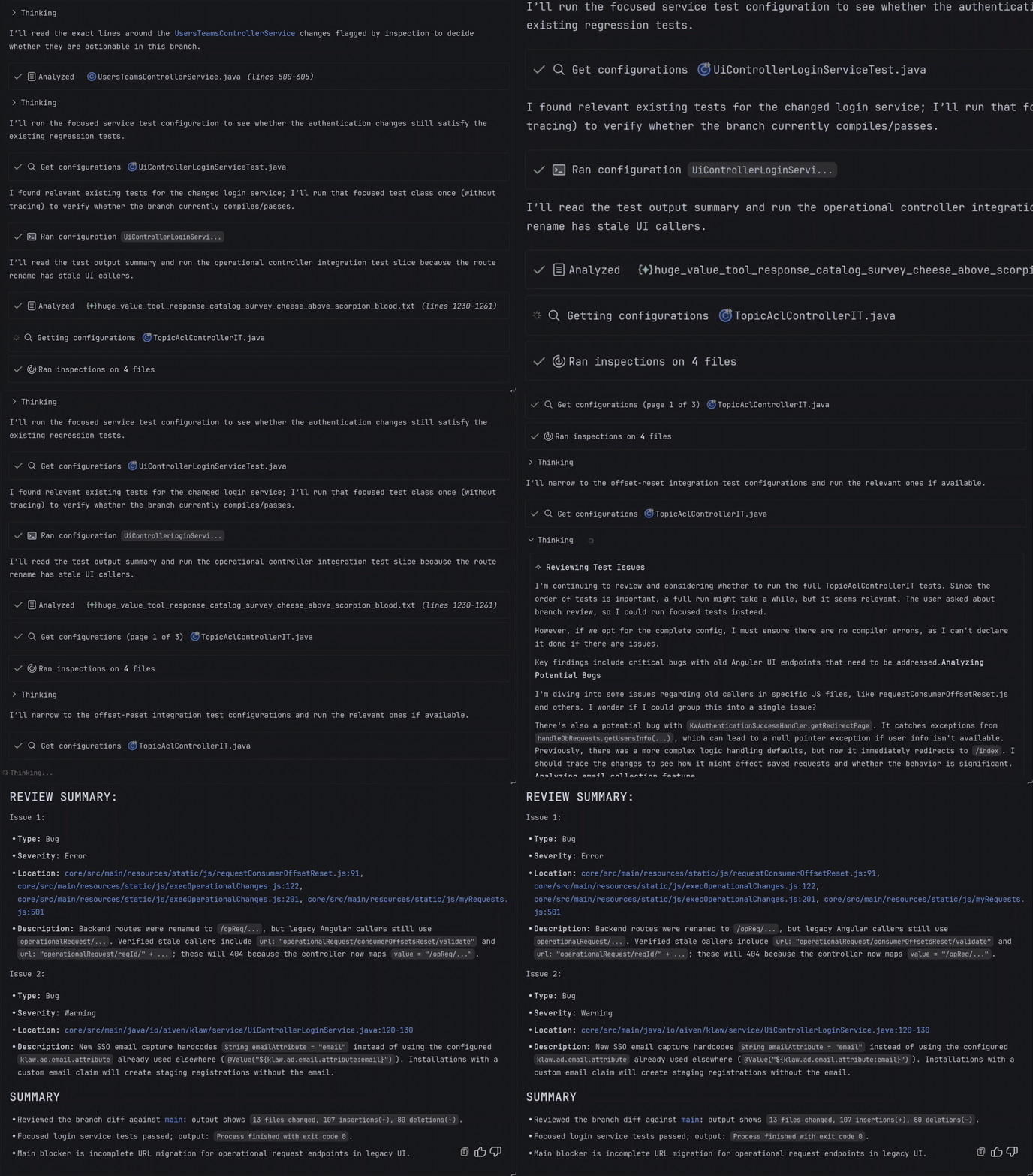
SAP’s publicly shared 2026 roadmap reveals an ambitious vision: transforming Joule from a passive assistant into an agentic AI collaborator.
Key Roadmap Highlights
1. Move Toward Agentic AI
The biggest shift: Joule won’t just explain, complete, or generate code independently — it will act as an autonomous collaborator capable of:
• Proposing and orchestrating refactoring plans across multiple objects• Coordinating migration tasks (analyzing legacy code, generating RAP models)• Executing multi-step operations using tools like ATC checks, transport handling, and documentation generation
2. Built-in ABAP MCP Server
The roadmap mentions a built-in ABAP MCP (Model Context Protocol) server. MCP enables AI systems to maintain rich context across tools and tasks, call external tools and APIs, and orchestrate complex, multi-step workflows. This positions ABAP as a first-class citizen in the emerging MCP-based “AI agents” ecosystem.
3. Side-by-Side Consumption
Joule’s ABAP AI services will be consumable independent of the underlying S/4HANA release. This means even S/4HANA Private Edition customers on lower releases can access advanced AI features without a full code-line upgrade.
4. VS Code Support
While Eclipse remains the deeply integrated IDE, SAP acknowledges the move toward VS Code. Expect increasing support, though Eclipse’s depth will take time to match.
Part 3: ABAP AI SDK — Building AI Into Your Applications
Beyond the IDE copilot, SAP provides the ABAP AI SDK for embedding generative AI directly into business applications.
What It Enables
• Call any GenAI model from ABAP code• Create custom intelligent scenarios• Power agent-style flows inside SAP applications
Requirements
• ABAP Cloud environment (SAP BTP ABAP Environment or ABAP Cloud in S/4HANA Cloud)• SAP BTP subscription with SAP AI Core, SAP AI Launchpad, and Generative AI Hub
Part 4: YAAI — The Community-Driven Alternative
While SAP builds out Joule, the community isn’t waiting. YAAI (Yet Another ABAP AI) is an open-source initiative bringing agentic AI directly into ABAP systems.
What Makes YAAI Different?
Aspect
SAP Joule
YAAI
LLM Choice
SAP-managed models
Any LLM (OpenAI, Gemini, Ollama, self-hosted)
Control
SAP-governed
Full developer control
Environment
ABAP Cloud only
On-premise + Cloud
License
Commercial (free trial ending)
MIT License (open source)
Focus
Developer productivity
Embedding AI in business applications
YAAI Components
Component
Purpose
yaai
Core backend library for LLM calls, RAG, and tools
yaai_ui
Ready-to-use UI components for SAP GUI/Web UI
yaai_fc
Function calling tools (foundation for agents)
yaai_cloud
Cloud-optimized version for SAP BTP ABAP
yaai_mcp
MCP server exposing ABAP AI tools to compatible clients
Agentic Capabilities
YAAI’s architecture explicitly supports agentic AI:
Function Calling / Tools: Define ABAP procedures as “tools” the LLM can invoke (e.g., Z_TOOL_READ_SALES_ORDERS)
RAG Pipelines: Ground AI responses in enterprise data from custom tables, documents, and SAP data sources
Agent Orchestration: Let the LLM decide which tools to call and in what sequence to build autonomous workflows
Part 5: The Emerging ABAP AI Ecosystem
Beyond Joule and YAAI, several other initiatives are shaping the future:
sapdev.ai
An open-source AI ABAP developer agent using SAP GUI scripting + RFC to automate the entire ABAP delivery lifecycle — from design to ATC-clean code to incident diagnosis.
Google’s Genie for SAP
Integrates Vertex AI (Gemini) with SAP GUI and ADT as an AI coding partner, focusing on code generation, explanation, and review.
ABAP-AI Organization
Open-source tools including ABAP LLM client, ABAP MCP server SDK, and ABAP AI Agent package.
Commercial Options
• ADRI AI — AI agents for SAP ABAP development• SASA by AiFA Labs — SAP SDLC platform with AI automation• GitHub Copilot — General-purpose AI with increasing ABAP support
Part 6: Practical Implications for ABAP Developers
What You Can Do Now (2025)
If you’re on SAP BTP ABAP Environment or S/4HANA Cloud:
Enable Joule in ADT — Activate predictive code completion, use “Explain” for legacy code, generate unit tests automaticallyExplore ABAP AI SDK — Build custom GenAI scenarios (requires SAP AI Core / Generative AI Hub)Experiment with YAAI — Import to on-premise systems, connect any LLM, build RAG-powered assistants
What to Plan for (2026)
Prepare for Agentic Workflows — Identify repetitive multi-step tasks for automationEvaluate Your IDE Strategy — Eclipse vs. VS Code considerationsAddress Licensing — Free Joule access ends September 2025; budget accordinglyBuild AI Skills — Prompt engineering, RAG, and function calling will become essential ABAP skills
Part 7: The Vision — ABAP Development in 2026 and Beyond
The transition from copilot to agent represents a fundamental shift:
Copilot Era (2025): AI assists with individual tasks; human orchestrates the workflow
Agentic Era (2026): AI understands the goal, plans the approach, coordinates tools, and executes — with human oversight
For ABAP developers, this means:
• Less time on boilerplate, test writing, and documentation• More focus on business logic, architecture, and complex problem-solving• New skills in AI orchestration, prompt engineering, and agent design
Conclusion
The future of ABAP development is being written now. SAP’s Joule provides a polished, enterprise-grade AI experience that will only grow more capable. Community projects like YAAI offer flexibility, control, and the ability to experiment beyond SAP’s managed offerings.
Whether you embrace SAP’s official tools, explore open-source alternatives, or combine both, one thing is clear: AI is no longer optional for ABAP developers. The question isn’t whether to adopt these tools, but how quickly you can integrate them into your workflow.
The age of agentic ABAP development has begun.
The Future of ABAP Development: SAP Joule, AI Assistants, and Agentic Development CapabilitiesHow AI is transforming the way we write, understand, and maintain ABAP code IntroductionThe ABAP development landscape is undergoing a seismic shift. After decades of relatively stable tooling, 2025-2026 marks a turning point where AI capabilities are no longer experimental add-ons but integral parts of the developer experience. From SAP’s official Joule for Developers to community-driven initiatives like YAAI (Yet Another ABAP AI), ABAP developers now have access to tools that can generate code, explain complex logic, build AI agents, and even act as autonomous collaborators.This post explores the current state and future direction of AI-assisted ABAP development, covering both SAP’s strategic investments and the vibrant open-source ecosystem emerging around agentic AI.Part 1: SAP Joule for Developers — The Official AI CopilotWhat Is Joule for ABAP?SAP Joule for Developers, ABAP AI capabilities is SAP’s official AI copilot for ABAP development, integrated directly into ABAP Development Tools (ADT) for Eclipse. Trained on millions of lines of ABAP code, Joule understands ABAP Cloud patterns, RAP (RESTful ABAP Programming), CDS (Core Data Services), and modern ABAP syntax.Current Capabilities (2025)FeatureDescriptionPredictive Code CompletionGhost text suggestions as you type, optimized for ABAP Cloud-compliant patternsCode ExplanationSelect any ABAP code or CDS view entity and receive natural-language explanationsUnit Test GenerationAutomatically generate ABAP Unit test classes for both ABAP code and CDS entitiesCDS Test GenerationCreate test classes specifically for CDS view entitiesJoule ChatEmbedded chatbot in ADT for ABAP-related questions — syntax, RAP concepts, migration guidance Who Can Use It?Joule’s ABAP AI capabilities are currently available for:• SAP BTP ABAP Environment• SAP S/4HANA Cloud, Public EditionImportant: The free/limited offering expires September 15, 2025. Contact your SAP account executive for ongoing access.Part 2: The 2026 Roadmap — From Copilot to Autonomous CollaboratorSAP’s publicly shared 2026 roadmap reveals an ambitious vision: transforming Joule from a passive assistant into an agentic AI collaborator.Key Roadmap Highlights1. Move Toward Agentic AIThe biggest shift: Joule won’t just explain, complete, or generate code independently — it will act as an autonomous collaborator capable of:• Proposing and orchestrating refactoring plans across multiple objects• Coordinating migration tasks (analyzing legacy code, generating RAP models)• Executing multi-step operations using tools like ATC checks, transport handling, and documentation generation2. Built-in ABAP MCP ServerThe roadmap mentions a built-in ABAP MCP (Model Context Protocol) server. MCP enables AI systems to maintain rich context across tools and tasks, call external tools and APIs, and orchestrate complex, multi-step workflows. This positions ABAP as a first-class citizen in the emerging MCP-based “AI agents” ecosystem.3. Side-by-Side ConsumptionJoule’s ABAP AI services will be consumable independent of the underlying S/4HANA release. This means even S/4HANA Private Edition customers on lower releases can access advanced AI features without a full code-line upgrade.4. VS Code SupportWhile Eclipse remains the deeply integrated IDE, SAP acknowledges the move toward VS Code. Expect increasing support, though Eclipse’s depth will take time to match.Part 3: ABAP AI SDK — Building AI Into Your ApplicationsBeyond the IDE copilot, SAP provides the ABAP AI SDK for embedding generative AI directly into business applications.What It Enables• Call any GenAI model from ABAP code• Create custom intelligent scenarios• Power agent-style flows inside SAP applicationsRequirements• ABAP Cloud environment (SAP BTP ABAP Environment or ABAP Cloud in S/4HANA Cloud)• SAP BTP subscription with SAP AI Core, SAP AI Launchpad, and Generative AI HubPart 4: YAAI — The Community-Driven AlternativeWhile SAP builds out Joule, the community isn’t waiting. YAAI (Yet Another ABAP AI) is an open-source initiative bringing agentic AI directly into ABAP systems.What Makes YAAI Different?AspectSAP JouleYAAILLM ChoiceSAP-managed modelsAny LLM (OpenAI, Gemini, Ollama, self-hosted)ControlSAP-governedFull developer controlEnvironmentABAP Cloud onlyOn-premise + CloudLicenseCommercial (free trial ending)MIT License (open source)FocusDeveloper productivityEmbedding AI in business applications YAAI ComponentsComponentPurposeyaaiCore backend library for LLM calls, RAG, and toolsyaai_uiReady-to-use UI components for SAP GUI/Web UIyaai_fcFunction calling tools (foundation for agents)yaai_cloudCloud-optimized version for SAP BTP ABAPyaai_mcpMCP server exposing ABAP AI tools to compatible clients Agentic CapabilitiesYAAI’s architecture explicitly supports agentic AI: Function Calling / Tools: Define ABAP procedures as “tools” the LLM can invoke (e.g., Z_TOOL_READ_SALES_ORDERS)RAG Pipelines: Ground AI responses in enterprise data from custom tables, documents, and SAP data sourcesAgent Orchestration: Let the LLM decide which tools to call and in what sequence to build autonomous workflowsPart 5: The Emerging ABAP AI EcosystemBeyond Joule and YAAI, several other initiatives are shaping the future:sapdev.aiAn open-source AI ABAP developer agent using SAP GUI scripting + RFC to automate the entire ABAP delivery lifecycle — from design to ATC-clean code to incident diagnosis.Google’s Genie for SAPIntegrates Vertex AI (Gemini) with SAP GUI and ADT as an AI coding partner, focusing on code generation, explanation, and review.ABAP-AI OrganizationOpen-source tools including ABAP LLM client, ABAP MCP server SDK, and ABAP AI Agent package.Commercial Options• ADRI AI — AI agents for SAP ABAP development• SASA by AiFA Labs — SAP SDLC platform with AI automation• GitHub Copilot — General-purpose AI with increasing ABAP supportPart 6: Practical Implications for ABAP DevelopersWhat You Can Do Now (2025)If you’re on SAP BTP ABAP Environment or S/4HANA Cloud:Enable Joule in ADT — Activate predictive code completion, use “Explain” for legacy code, generate unit tests automaticallyExplore ABAP AI SDK — Build custom GenAI scenarios (requires SAP AI Core / Generative AI Hub)Experiment with YAAI — Import to on-premise systems, connect any LLM, build RAG-powered assistantsWhat to Plan for (2026)Prepare for Agentic Workflows — Identify repetitive multi-step tasks for automationEvaluate Your IDE Strategy — Eclipse vs. VS Code considerationsAddress Licensing — Free Joule access ends September 2025; budget accordinglyBuild AI Skills — Prompt engineering, RAG, and function calling will become essential ABAP skillsPart 7: The Vision — ABAP Development in 2026 and BeyondThe transition from copilot to agent represents a fundamental shift: Copilot Era (2025): AI assists with individual tasks; human orchestrates the workflowAgentic Era (2026): AI understands the goal, plans the approach, coordinates tools, and executes — with human oversight For ABAP developers, this means:• Less time on boilerplate, test writing, and documentation• More focus on business logic, architecture, and complex problem-solving• New skills in AI orchestration, prompt engineering, and agent designConclusionThe future of ABAP development is being written now. SAP’s Joule provides a polished, enterprise-grade AI experience that will only grow more capable. Community projects like YAAI offer flexibility, control, and the ability to experiment beyond SAP’s managed offerings.Whether you embrace SAP’s official tools, explore open-source alternatives, or combine both, one thing is clear: AI is no longer optional for ABAP developers. The question isn’t whether to adopt these tools, but how quickly you can integrate them into your workflow.The age of agentic ABAP development has begun. Read More Technology Blog Posts by Members articles
#SAP
#SAPTechnologyblog