Video Review: Two Months With the M4 MacBook Air

It’s been nearly two months since the M4 MacBook Air launched, so we thought we’d take another look at the machine now that it’s been out long enough to do some serious testing with it.

Introduced in March, the ‌MacBook Air‌ is equipped with Apple’s latest and greatest M4 chip, so it’s more than capable of handling day-to-day tasks from web browsing and watching videos to getting work done. It’s even powerful enough for photo editing and some light video editing work.

All Macs have a minimum of 16GB RAM now, so the base M4 ‌MacBook Air‌ that starts at $999 is a really good deal for what you get. You can upgrade the RAM and the SSD, which may be worthwhile depending on what you want to do on your Mac.

In terms of design, Apple hasn’t changed the look of the M4 ‌MacBook Air‌ compared to the M3 model, but it does come in a subtle blue shade that’s new this year. The ‌MacBook Air‌ continues to be Apple’s most portable Mac, with the 13-inch model weighing just 2.7 pounds. The 15-inch model is heavier at 3.3 pounds, but both models are lighter than the equivalent MacBook Pro models.

There’s an upgraded 12-megapixel front-facing camera for video calls this year, which is a nice upgrade over the prior 1080p camera. The ‌MacBook Air‌ is limited to two USB-C ports and it doesn’t have the port selection of the ‌MacBook Pro‌, nor the ability to support as many displays, but it’s perfect for on-the-go use and it is the Mac that we recommend for most people.

With the ‌MacBook Pro‌, you’re going to get a better mini-LED display, ProMotion support, and the option for nano-texture, but those all come with a much higher price tag.

Make sure to watch our review video for more on our thoughts on the M4 ‌MacBook Air‌ after spending almost two months with it.

Related Roundup: MacBook Air
Related Forum: MacBook Air

This article, “Video Review: Two Months With the M4 MacBook Air” first appeared on MacRumors.com

Discuss this article in our forums


​ It’s been nearly two months since the M4 MacBook Air launched, so we thought we’d take another look at the machine now that it’s been out long enough to do some serious testing with it.

Subscribe to the MacRumors YouTube channel for more videos.
Introduced in March, the ‌MacBook Air‌ is equipped with Apple’s latest and greatest M4 chip, so it’s more than capable of handling day-to-day tasks from web browsing and watching videos to getting work done. It’s even powerful enough for photo editing and some light video editing work.

All Macs have a minimum of 16GB RAM now, so the base M4 ‌MacBook Air‌ that starts at $999 is a really good deal for what you get. You can upgrade the RAM and the SSD, which may be worthwhile depending on what you want to do on your Mac.

In terms of design, Apple hasn’t changed the look of the M4 ‌MacBook Air‌ compared to the M3 model, but it does come in a subtle blue shade that’s new this year. The ‌MacBook Air‌ continues to be Apple’s most portable Mac, with the 13-inch model weighing just 2.7 pounds. The 15-inch model is heavier at 3.3 pounds, but both models are lighter than the equivalent MacBook Pro models.

There’s an upgraded 12-megapixel front-facing camera for video calls this year, which is a nice upgrade over the prior 1080p camera. The ‌MacBook Air‌ is limited to two USB-C ports and it doesn’t have the port selection of the ‌MacBook Pro‌, nor the ability to support as many displays, but it’s perfect for on-the-go use and it is the Mac that we recommend for most people.

With the ‌MacBook Pro‌, you’re going to get a better mini-LED display, ProMotion support, and the option for nano-texture, but those all come with a much higher price tag.

Make sure to watch our review video for more on our thoughts on the M4 ‌MacBook Air‌ after spending almost two months with it.Related Roundup: MacBook AirBuyer’s Guide: 15″ MacBook Air (Buy Now), 13″ MacBook Air (Buy Now)Related Forum: MacBook AirThis article, “Video Review: Two Months With the M4 MacBook Air” first appeared on MacRumors.comDiscuss this article in our forums   Read More MacRumors: Mac News and Rumors – All Stories 

#Techno #PCWorld

You May Also Like

More From Author

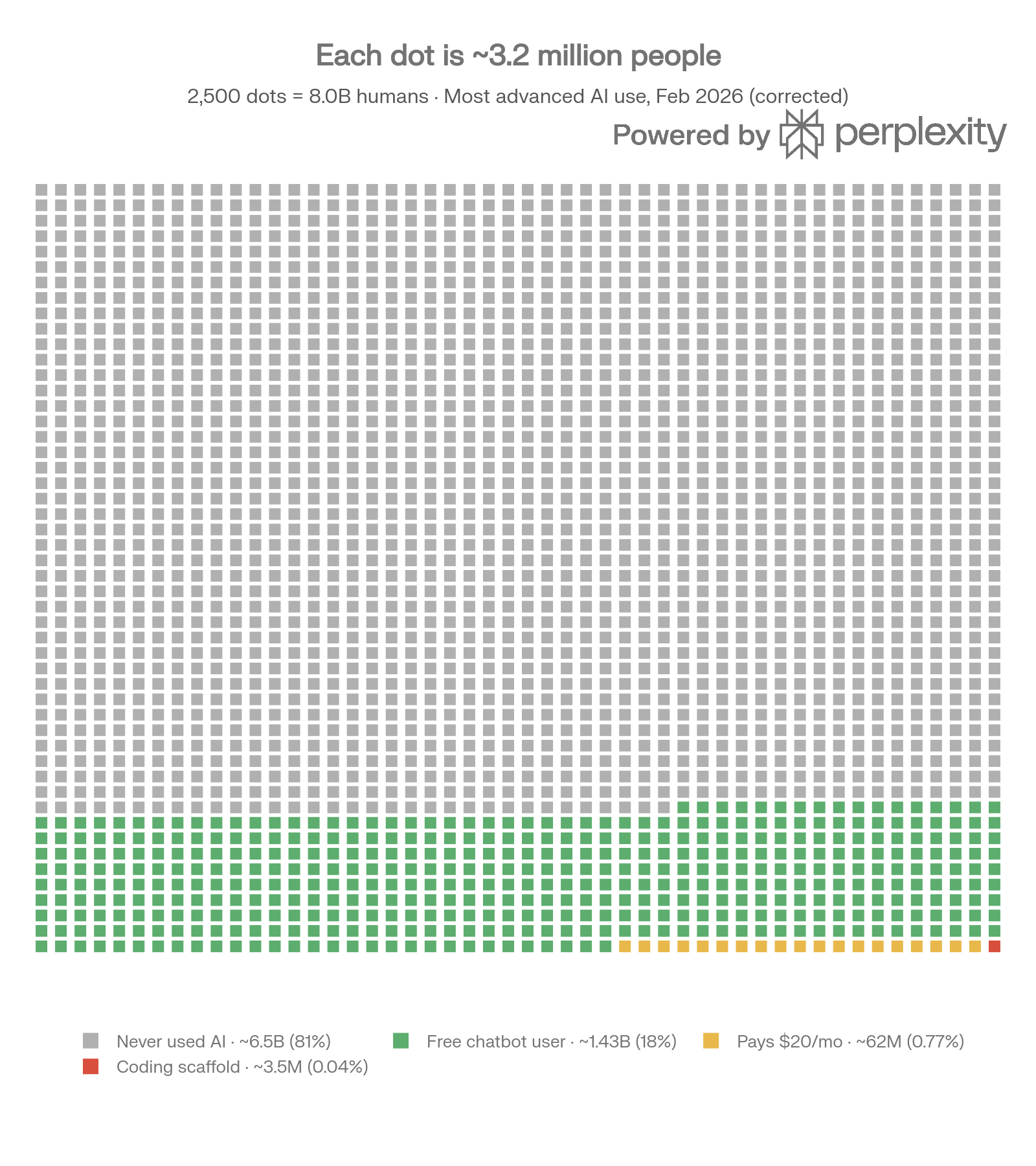
84% of Humanity Has Never Used AI. Here’s Why That Number Should Scare You — and Excite You.The AI revolution isn’t here yet. It’s loading.Open your Twitter feed, your LinkedIn, your YouTube recommendations. AI is everywhere, right? Every headline screams that the world has changed. Investors are pouring billions into it. Pundits say it’ll replace half of all jobs by 2030.But zoom out. Like, really zoom out.Picture 8.1 billion dots. Each one is a human being. Now color-code them by how advanced their AI interaction actually is.Here’s what you’d see.A Sea of Gray84% of humanity — 6.8 billion people — have never used an AI tool. Not once.Not ChatGPT. Not Gemini. Not even a basic AI chatbot on a customer service page. Nothing.That’s not a rounding error. That’s almost every human being alive.We talk about AI like it’s oxygen — invisible and everywhere. But for most of the world, AI is still science fiction. It’s something they’ve heard about, maybe seen in a news segment, but never touched. They’re not resisting it. It simply hasn’t reached them yet.That gray is overwhelming. And it tells a story most people in the AI conversation completely miss.The Green Sliver at the Bottom16% — about 1.3 billion people — have used a free AI chatbot.This is the group that typed a question into ChatGPT once. Maybe used it to write a birthday message or settle a dinner table argument. They’ve dipped a toe in.This is what the mainstream media calls “the AI revolution.”A single conversation. A curiosity click. A “wow, that’s cool” moment before they closed the tab and never went back.That’s the ceiling for most people who’ve touched AI at all. And it’s still only 1 in 6 humans on the planet.The Tiny Yellow Band0.3% — somewhere between 15 and 60 million people — pay for AI.This is where it gets interesting. If you’re reading this on Medium, there’s a solid chance you’re in this group. You’ve got a ChatGPT Plus subscription, maybe Claude Pro, maybe Perplexity. You use AI regularly. You’ve seen what it can actually do when you push it.You feel like you’re part of something mainstream because everyone you know seems to be using it.They’re not. You are surrounded by a bubble of early adopters so thick that it feels like the whole world — but it’s 3 out of every 1,000 people on Earth.Let that sit for a second.The Nearly Invisible Red0.04% — roughly 2 to 5 million people — are using AI to build.Cursor. GitHub Copilot. AI coding scaffolds. Agentic workflows. These are people who aren’t just asking AI questions — they’re using it as a co-pilot to create things: software, products, companies, systems.This is AI at its highest current level of human interaction.And it’s so small on the chart that you almost can’t see it.What This Actually MeansHere’s the uncomfortable truth the tech industry doesn’t want to say too loudly:We are not in the AI age. We are in the “early adopters telling everyone it’s the AI age” age.The real wave hasn’t hit. Not even close.Think about the early internet. In 1995, a tiny fraction of people had ever visited a website. The people who got it early — who built skills, products, and audiences while everyone else shrugged — went on to define the next 30 years of business and culture.AI is at that exact moment right now.The gap between the 0.04% who build with AI and the 84% who’ve never touched it is not just a statistic. It’s the largest skills arbitrage opportunity most of us will ever see in our lifetimes.The Three Windows AheadHistory shows us there are three windows in any technological shift:The Builder Window — the 0.04% who create tools and systems with the technologyThe Learner Window — the people who deeply understand and fluently use it before the masses arriveThe Passenger Window — everyone else, who eventually adopts it because they have no choice, but on someone else’s termsRight now, windows 1 and 2 are still wide open.The people developing genuine AI fluency today — not “I asked ChatGPT for a recipe” fluency, but deep, workflow-integrated, problem-solving fluency — are building an advantage that will compound for years.Which Dot Are You?Look at that chart one more time.If you’re reading this article, you’re already ahead of 84% of the world just by paying attention. The question is what you do with the next 6 months.The gray dots aren’t your competition. They’re your future audience, your future customers, your future employees who will need someone to show them how this works.The red dots aren’t unreachable gods. They’re mostly just people who started earlier and stayed curious longer.The distance between where you are and where the opportunity is isn’t talent. It’s not even time.It’s intentionality.Which dot are you right now — and which one do you want to be by the end of the year? Drop it in the comments.Tags: Artificial Intelligence · Technology · Future Of Work · Productivity · ChatGPT

84% of Humanity Has Never Used AI. Here’s Why That Number Should Scare You — and Excite You.The AI revolution isn’t here yet. It’s loading.Open your Twitter feed, your LinkedIn, your YouTube recommendations. AI is everywhere, right? Every headline screams that the world has changed. Investors are pouring billions into it. Pundits say it’ll replace half of all jobs by 2030.But zoom out. Like, really zoom out.Picture 8.1 billion dots. Each one is a human being. Now color-code them by how advanced their AI interaction actually is.Here’s what you’d see.A Sea of Gray84% of humanity — 6.8 billion people — have never used an AI tool. Not once.Not ChatGPT. Not Gemini. Not even a basic AI chatbot on a customer service page. Nothing.That’s not a rounding error. That’s almost every human being alive.We talk about AI like it’s oxygen — invisible and everywhere. But for most of the world, AI is still science fiction. It’s something they’ve heard about, maybe seen in a news segment, but never touched. They’re not resisting it. It simply hasn’t reached them yet.That gray is overwhelming. And it tells a story most people in the AI conversation completely miss.The Green Sliver at the Bottom16% — about 1.3 billion people — have used a free AI chatbot.This is the group that typed a question into ChatGPT once. Maybe used it to write a birthday message or settle a dinner table argument. They’ve dipped a toe in.This is what the mainstream media calls “the AI revolution.”A single conversation. A curiosity click. A “wow, that’s cool” moment before they closed the tab and never went back.That’s the ceiling for most people who’ve touched AI at all. And it’s still only 1 in 6 humans on the planet.The Tiny Yellow Band0.3% — somewhere between 15 and 60 million people — pay for AI.This is where it gets interesting. If you’re reading this on Medium, there’s a solid chance you’re in this group. You’ve got a ChatGPT Plus subscription, maybe Claude Pro, maybe Perplexity. You use AI regularly. You’ve seen what it can actually do when you push it.You feel like you’re part of something mainstream because everyone you know seems to be using it.They’re not. You are surrounded by a bubble of early adopters so thick that it feels like the whole world — but it’s 3 out of every 1,000 people on Earth.Let that sit for a second.The Nearly Invisible Red0.04% — roughly 2 to 5 million people — are using AI to build.Cursor. GitHub Copilot. AI coding scaffolds. Agentic workflows. These are people who aren’t just asking AI questions — they’re using it as a co-pilot to create things: software, products, companies, systems.This is AI at its highest current level of human interaction.And it’s so small on the chart that you almost can’t see it.What This Actually MeansHere’s the uncomfortable truth the tech industry doesn’t want to say too loudly:We are not in the AI age. We are in the “early adopters telling everyone it’s the AI age” age.The real wave hasn’t hit. Not even close.Think about the early internet. In 1995, a tiny fraction of people had ever visited a website. The people who got it early — who built skills, products, and audiences while everyone else shrugged — went on to define the next 30 years of business and culture.AI is at that exact moment right now.The gap between the 0.04% who build with AI and the 84% who’ve never touched it is not just a statistic. It’s the largest skills arbitrage opportunity most of us will ever see in our lifetimes.The Three Windows AheadHistory shows us there are three windows in any technological shift:The Builder Window — the 0.04% who create tools and systems with the technologyThe Learner Window — the people who deeply understand and fluently use it before the masses arriveThe Passenger Window — everyone else, who eventually adopts it because they have no choice, but on someone else’s termsRight now, windows 1 and 2 are still wide open.The people developing genuine AI fluency today — not “I asked ChatGPT for a recipe” fluency, but deep, workflow-integrated, problem-solving fluency — are building an advantage that will compound for years.Which Dot Are You?Look at that chart one more time.If you’re reading this article, you’re already ahead of 84% of the world just by paying attention. The question is what you do with the next 6 months.The gray dots aren’t your competition. They’re your future audience, your future customers, your future employees who will need someone to show them how this works.The red dots aren’t unreachable gods. They’re mostly just people who started earlier and stayed curious longer.The distance between where you are and where the opportunity is isn’t talent. It’s not even time.It’s intentionality.Which dot are you right now — and which one do you want to be by the end of the year? Drop it in the comments.Tags: Artificial Intelligence · Technology · Future Of Work · Productivity · ChatGPT