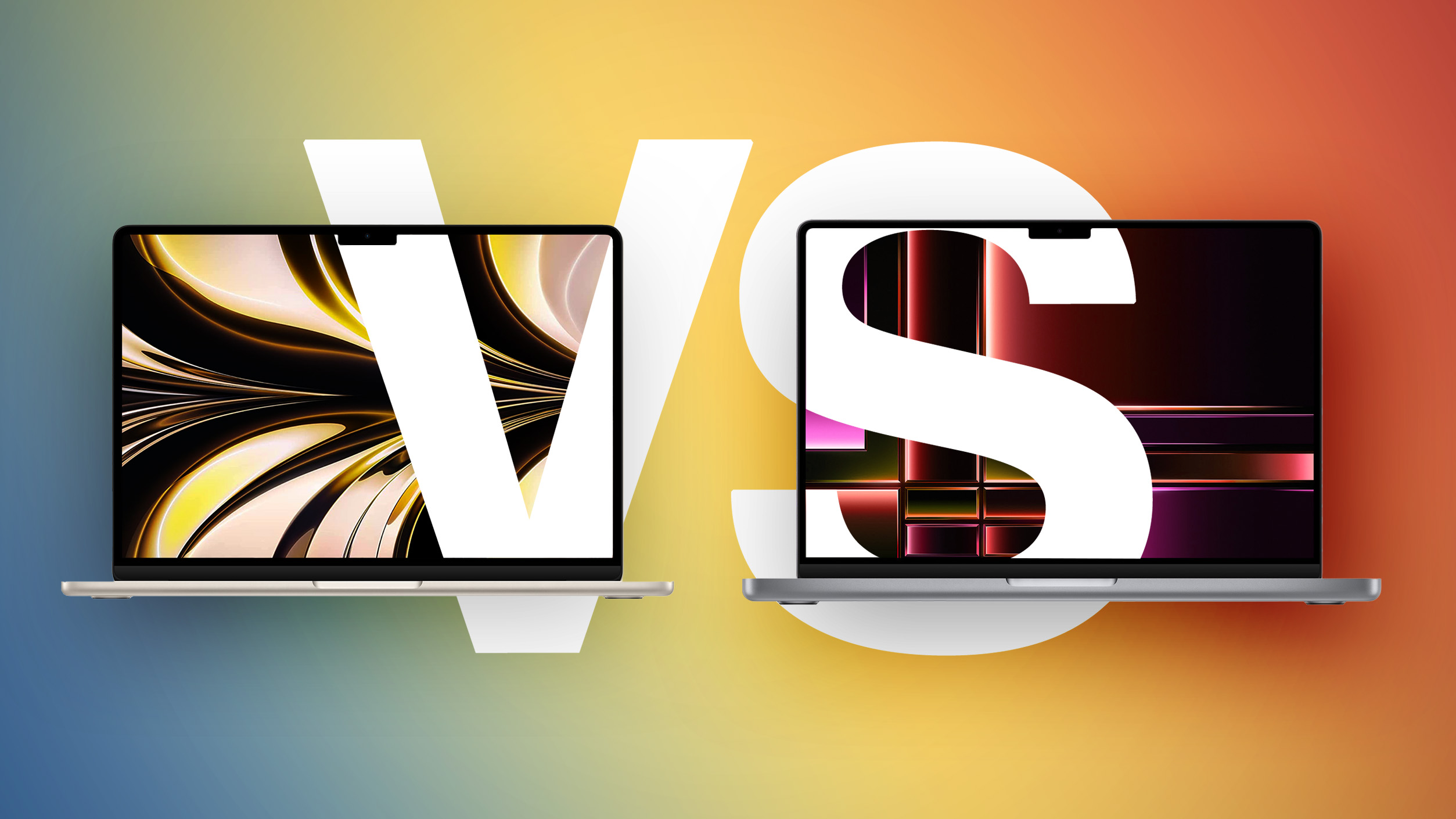
Both the MacBook Air and entry-level MacBook Pro now feature the M5 chip, so how do the latest models compare?
While the 13-inch MacBook Air starts at $1,099 and the 15-inch model at $1,299, moving to the 14-inch MacBook Pro requires spending at least $300 more. For some buyers, the extra cost is unnecessary; for others, the Pro’s ability to sustain performance, along with its more advanced display and expanded I/O, meaningfully change the experience in ways the Air cannot match even with higher configurations.
With the introduction of the MacBook Neo as a new entry-level option, the Mac lineup now spans three distinct tiers. As a result, the MacBook Air no longer represents the default choice for most buyers, but instead occupies a middle position between affordability and performance. If you’ve already ruled out the MacBook Neo, this guide helps to answer the question of how to decide which of Apple’s other two popular laptops is best for you. The key differences are as follows:
MacBook Air
MacBook Pro
13.6- or 15.3-inch display
14.2-inch display
Slimmer borders around the display
LCD Liquid Retina display
Mini-LED Liquid Retina XDR display
60Hz refresh rate
ProMotion for refresh rates up to 120Hz
Up to 500 nits brightness
Up to 1,000 nits brightness and 1,600 nits peak HDR brightness
Nano-texture display option
Passive cooling
Active cooling
Two Thunderbolt 4 (USB-C) ports
Three Thunderbolt 4 (USB-C) ports
HDMI 2.1 port with support for multichannel audio output
SDXC card slot
13-Inch: Four-speaker sound system
15-Inch: Six-speaker sound system with force-canceling woofers
High-fidelity six-speaker sound system with force-cancelling woofers
Three-mic array with directional beamforming
Studio-quality three-mic array with high signal-to-noise ratio and directional beamforming
512GB, 1TB, or 2TB of storage
512GB, 1TB, 2TB, or 4TB storage
13-Inch: 53.8-watt-hour lithium-polymer battery
15-Inch: 66.5-watt-hour lithium-polymer battery
14-Inch: 72.4-watt-hour lithium-polymer battery
18-hour battery life
24-hour battery life
30W, 35W, or 70W USB-C Power Adapter
70W or 96W USB-C Power Adapter
Silver, Sky Blue, Starlight, or Midnight color options
Silver or Space Black color options
13-Inch: Starts at $1,099
15-Inch: Starts at $1,299
Starts at $1,599
Dimensions are also a key area of difference between the MacBook Air and MacBook Pro. The MacBook Pro is noticeably thicker and heavier than both MacBook Air models:
MacBook Air (13-Inch)
MacBook Air (15-Inch)
MacBook Pro (14-Inch)
Height
0.44 inches (1.13 cm)
0.45 inch (1.15 cm)
0.61 inches (1.55 cm)
Width
11.97 inches (30.41 cm)
13.40 inches (34.04 cm)
12.31 inches (31.26 cm)
Depth
8.46 inches (21.5 cm)
9.35 inches (23.76 cm)
8.71 inches (22.12 cm)
Weight
2.7 pounds (1.24 kg)
3.3 pounds (1.51 kg)
3.4 pounds (1.55 kg)
Taken as a whole, the MacBook Air now occupies a more clearly defined middle position in Apple’s laptop lineup. With the introduction of the MacBook Neo as a lower-cost entry point, the Air no longer represents the default choice for most buyers, but instead serves those who want a meaningful step up in performance, features, and long-term usability without moving into the MacBook Pro tier.
The MacBook Air offers excellent performance with the M5 chip, capable memory and storage options, a good all-round display, and key features like a backlit keyboard, 18 hours of battery life, and a 12MP Center Stage camera. For everyday tasks, performance remains effectively indistinguishable from more expensive models, but the Air is far less likely to feel constrained after several years of use compared to the MacBook Neo. Its thinner chassis, lower weight, silent fanless design, and broader range of color options also remain important advantages.
By contrast, the 14-inch MacBook Pro is differentiated less by baseline performance and more by its ability to sustain it, as well as by a collection of hardware features that materially change the experience. Active cooling allows the M5 chip to operate at higher levels for prolonged periods, avoiding the thermal limitations inherent to the Air’s passive design. This becomes noticeable in extended workloads such as video editing, 3D rendering, compiling large codebases, or running intensive AI-driven tasks. If your workload regularly involves sustained performance, such as long video exports, large code builds, or intensive multitasking, the MacBook Air’s fanless design may become a limiting factor.
Alongside this, MacBook Pro’s mini-LED Liquid Retina XDR display with ProMotion offers substantially higher brightness, contrast, and motion fluidity, while the inclusion of HDMI, SDXC, and an additional Thunderbolt port expands its versatility in professional environments. It also delivers consistently better speakers, higher-quality microphones, and longer battery life. For users planning to keep their machine for several years, this sustained performance headroom and broader feature set can make the MacBook Pro a more resilient long-term investment.
The most consequential trade-off emerges at the upper end of the MacBook Air’s pricing. At $1,299, the 15-inch MacBook Air sits close enough to the 14-inch MacBook Pro’s $1,599 starting price that the decision becomes less about affordability and more about priorities. For an additional $300, the Pro offers a significantly more advanced display, active cooling for sustained performance, longer battery life, additional I/O, and overall greater versatility. Once you are already considering spending over $1,000 on a laptop, these advantages become disproportionately impactful, particularly for users intending to keep their machine for several years.
As a result, the MacBook Air is best understood as the balanced option within the lineup: Meaningfully more capable and longer-lasting than the MacBook Neo, but somewhat constrained compared to the MacBook Pro. The right choice depends less on basic specifications and more on where your needs sit across three distinct tiers, with basic computing at the low end, sustained performance and advanced features at the high end, and the MacBook Air positioned squarely between them.
This article, “M5 MacBook Air vs. M5 MacBook Pro Buyer’s Guide” first appeared on MacRumors.com
Discuss this article in our forums
Both the MacBook Air and entry-level MacBook Pro now feature the M5 chip, so how do the latest models compare?
While the 13-inch MacBook Air starts at $1,099 and the 15-inch model at $1,299, moving to the 14-inch MacBook Pro requires spending at least $300 more. For some buyers, the extra cost is unnecessary; for others, the Pro’s ability to sustain performance, along with its more advanced display and expanded I/O, meaningfully change the experience in ways the Air cannot match even with higher configurations.
With the introduction of the MacBook Neo as a new entry-level option, the Mac lineup now spans three distinct tiers. As a result, the MacBook Air no longer represents the default choice for most buyers, but instead occupies a middle position between affordability and performance. If you’ve already ruled out the MacBook Neo, this guide helps to answer the question of how to decide which of Apple’s other two popular laptops is best for you. The key differences are as follows:
MacBook Air
MacBook Pro
13.6- or 15.3-inch display
14.2-inch display
Slimmer borders around the display
LCD Liquid Retina display
Mini-LED Liquid Retina XDR display
60Hz refresh rate
ProMotion for refresh rates up to 120Hz
Up to 500 nits brightness
Up to 1,000 nits brightness and 1,600 nits peak HDR brightness
Nano-texture display option
Passive cooling
Active cooling
Two Thunderbolt 4 (USB-C) ports
Three Thunderbolt 4 (USB-C) ports
HDMI 2.1 port with support for multichannel audio output
SDXC card slot
13-Inch: Four-speaker sound system
15-Inch: Six-speaker sound system with force-canceling woofers
High-fidelity six-speaker sound system with force-cancelling woofers
Three-mic array with directional beamforming
Studio-quality three-mic array with high signal-to-noise ratio and directional beamforming
512GB, 1TB, or 2TB of storage
512GB, 1TB, 2TB, or 4TB storage
13-Inch: 53.8-watt-hour lithium-polymer battery
15-Inch: 66.5-watt-hour lithium-polymer battery
14-Inch: 72.4-watt-hour lithium-polymer battery
18-hour battery life
24-hour battery life
30W, 35W, or 70W USB-C Power Adapter
70W or 96W USB-C Power Adapter
Silver, Sky Blue, Starlight, or Midnight color options
Silver or Space Black color options
13-Inch: Starts at $1,099
15-Inch: Starts at $1,299
Starts at $1,599
Dimensions are also a key area of difference between the MacBook Air and MacBook Pro. The MacBook Pro is noticeably thicker and heavier than both MacBook Air models:
MacBook Air (13-Inch)
MacBook Air (15-Inch)
MacBook Pro (14-Inch)
Height
0.44 inches (1.13 cm)
0.45 inch (1.15 cm)
0.61 inches (1.55 cm)
Width
11.97 inches (30.41 cm)
13.40 inches (34.04 cm)
12.31 inches (31.26 cm)
Depth
8.46 inches (21.5 cm)
9.35 inches (23.76 cm)
8.71 inches (22.12 cm)
Weight
2.7 pounds (1.24 kg)
3.3 pounds (1.51 kg)
3.4 pounds (1.55 kg)
Taken as a whole, the MacBook Air now occupies a more clearly defined middle position in Apple’s laptop lineup. With the introduction of the MacBook Neo as a lower-cost entry point, the Air no longer represents the default choice for most buyers, but instead serves those who want a meaningful step up in performance, features, and long-term usability without moving into the MacBook Pro tier.
The MacBook Air offers excellent performance with the M5 chip, capable memory and storage options, a good all-round display, and key features like a backlit keyboard, 18 hours of battery life, and a 12MP Center Stage camera. For everyday tasks, performance remains effectively indistinguishable from more expensive models, but the Air is far less likely to feel constrained after several years of use compared to the MacBook Neo. Its thinner chassis, lower weight, silent fanless design, and broader range of color options also remain important advantages.
By contrast, the 14-inch MacBook Pro is differentiated less by baseline performance and more by its ability to sustain it, as well as by a collection of hardware features that materially change the experience. Active cooling allows the M5 chip to operate at higher levels for prolonged periods, avoiding the thermal limitations inherent to the Air’s passive design. This becomes noticeable in extended workloads such as video editing, 3D rendering, compiling large codebases, or running intensive AI-driven tasks. If your workload regularly involves sustained performance, such as long video exports, large code builds, or intensive multitasking, the MacBook Air’s fanless design may become a limiting factor.
Alongside this, MacBook Pro’s mini-LED Liquid Retina XDR display with ProMotion offers substantially higher brightness, contrast, and motion fluidity, while the inclusion of HDMI, SDXC, and an additional Thunderbolt port expands its versatility in professional environments. It also delivers consistently better speakers, higher-quality microphones, and longer battery life. For users planning to keep their machine for several years, this sustained performance headroom and broader feature set can make the MacBook Pro a more resilient long-term investment.
The most consequential trade-off emerges at the upper end of the MacBook Air’s pricing. At $1,299, the 15-inch MacBook Air sits close enough to the 14-inch MacBook Pro’s $1,599 starting price that the decision becomes less about affordability and more about priorities. For an additional $300, the Pro offers a significantly more advanced display, active cooling for sustained performance, longer battery life, additional I/O, and overall greater versatility. Once you are already considering spending over $1,000 on a laptop, these advantages become disproportionately impactful, particularly for users intending to keep their machine for several years.
As a result, the MacBook Air is best understood as the balanced option within the lineup: Meaningfully more capable and longer-lasting than the MacBook Neo, but somewhat constrained compared to the MacBook Pro. The right choice depends less on basic specifications and more on where your needs sit across three distinct tiers, with basic computing at the low end, sustained performance and advanced features at the high end, and the MacBook Air positioned squarely between them.Related Roundups: MacBook Pro, MacBook AirBuyer’s Guide: MacBook Pro (Buy Now), MacBook Air (Buy Now)Related Forums: MacBook Pro, MacBook AirThis article, “M5 MacBook Air vs. M5 MacBook Pro Buyer’s Guide” first appeared on MacRumors.comDiscuss this article in our forums Read More MacRumors: Mac News and Rumors – All Stories
#Techno #PCWorld